The Tohu have a saying: "The mountain is not dangerous. The mountain is precise." What they mean is that most deaths on Pyros are not accidents in the ordinary sense — they are the mountain accurately reading a person and returning its reading. Understanding the perils of Pyros is understanding your own current state. This guide is organized by hazard, but the real guide is a long, honest look in the mirror before you set foot on the black rock.
Peril 1 — The Breath That Tastes (Phlogiston-V Gas)
The shimmering zone — visible before it is felt, felt before it is understood
The gas the company calls Phlogiston-V and the Tohu call the breath that tastes saturates the air above approximately 220 metres elevation on Pyros. On its own it does nothing. In the presence of trace volatile organic compounds produced by the metabolic breakdown of sustained human vice, it does what fire does.
Specifically: alcohol metabolizes in the body over time to acetaldehyde, which is exhaled in trace quantities for days after the original consumption. The Phlogiston-V finds acetaldehyde and ignites it. The result is a flame — small, localized to the space immediately in front of the drinker's mouth — that the Tohu describe as the mountain clearing its throat. A warning. A first taste. If the person continues to breathe deeply, the flame grows and becomes something worse.
Sustained cortisol — the chemical signature of chronic greed, unrelenting ambition, and a life of overextension — metabolizes through sweat glands to compounds the gas also recognizes. For this category of person, the fire is different: a low blue flame, patient, that finds the skin wherever sweat pools and walks along it. It is slower than the drinker's fire. It is more thoroughgoing.
The gas's detection threshold maps precisely to the smell of velu fruit left three days in the heat. Fresh velu smells of aggressive, face-collapsing sourness. Three-day velu smells sweet, turned, overripe — the smell of fruit that has decided to be something else. If you cannot identify this smell from the company's fruit bowl at the Lodge briefing, ask the Tohu to show you. If you can identify the smell, and you then catch it around your own face on the mountain, stop immediately. Breathe slow. Breathe small. Through the nose, not the mouth. The fire feeds on your breath; the less breath you give it, the less it has to eat.
The Tohu's protocol for a first flame: stop moving. Take a breath in through the nose, slow, as if you are trying not to disturb a spider. Let it out the same way. Do not open the mouth. Do not run — running demands large breaths. Stand still and give the gas nothing, and it will wait. Move again when the body is calm. The calm body feeds the flame less than the frightened one. Fear, the Tohu have noted, is itself a small drink: it produces its own compounds. Standing beside the flame frightened is not much better than standing beside it drunk.
A note on the clean body: those who carry nothing the gas can use — metabolically and chemically — experience the gas as nothing at all. The air parts. The heat opens a corridor. There is no smell, no shimmer that tracks them, no awareness from the mountain of their presence. They walk through the Sieve as through a mild warm wind. This is not a metaphor and not a spiritual claim. It is the chemical fact of a body that has nothing combustible on offer.
Peril 2 — The Grey Lichen
In the cracks between the glass plates on Pyros's surface — throughout the glass field zones, from the First Glass Field all the way to the Sieve — a pale grey lichen grows. It is soft as fur. It appears harmless. It is not harmless.
The grey lichen enters an open wound the way water enters sand. A cut on the palm, on the forearm, on the foot — any wound where the skin has been broken and then contacted the glass surface — provides a point of entry. Once in, the lichen does not cause immediate symptoms. It does not cause immediate anything. For the first day or two after contact, the wound looks normal. It is healing.
On day three — sometimes two, sometimes four — the fever begins. By the time the fever is perceptible, the lichen is no longer only in the wound. It is in the tissue surrounding the wound. Within 24 hours of fever onset, it is in the circulatory system. There is no known treatment at altitude. At sea level, with aggressive antibiotic intervention begun in the first hours of fever, survival is possible. Without treatment, the timeline from fever to death is approximately seven days.
The grey lichen is not judgmental. It does not care about your past. It does not respond to your metabolic chemistry. It responds only to open skin and the passage of time. This makes it the most democratic peril on Pyros: it kills the virtuous and the corrupt with equal efficiency, and a person who crosses the glass barefoot — including the Tohu — is at theoretical risk, though the Tohu's feet have developed a reading capacity that avoids the lichen-bearing cracks almost automatically. A boot-wearing, armor-clad hunter with cuts in their gloves has no such instinct.
Any skin that has been in contact with the glass surface should be checked each evening at camp. Any wound — however minor — should be cleaned with the company's provided antiseptic, covered, and not re-exposed to the rock surface while it remains open. Boots and gaiters should be inspected daily for cracks or gaps through which the lichen could contact skin through abrasion.
If fever begins above 2,000 metres, do not wait. Trigger the lume alert and request evacuation immediately. Every hour of delay is a lost hour of treatment window. The company's evacuation team carries broad-spectrum antibiotic intervention; fever onset is not a death sentence if acted on within the first six hours.
Peril 3 — Blood Thinning (Altitude Hypoxia)
The air of Pyros thins the blood. The mechanism is not standard altitude sickness — the Phlogiston-V atmosphere interacts with hemoglobin in ways that standard acclimatization cannot address. A healthy body at sea level reads 98–100 on the lume (blood oxygen saturation). Every 24 hours on the mountain, at elevation above the Lodge, a non-Tohu body loses approximately five to six points.
| Day | Typical Morning Reading | Status | Notes |
|---|---|---|---|
| Arrival | 97–100 | Normal | Sea-level baseline, Lodge briefing |
| Day 2 (morning) | 91–93 | Good | First Field night — ~6 point drop |
| Day 3 (morning) | 84–87 | Manageable | Deep Glass camp — hands beginning to shake |
| Day 4 (morning) | 77–82 | Caution | Crust approach — effort is costly |
| Day 5 (Sieve) | 66–76 | Critical | Company evacuation threshold: 70 |
| Day 5 (documented low) | 58 | Life-threatening | One survivor documented at this reading |
At 70 or below, the company's protocol activates automatically: a team is dispatched from the Lodge with oxygen and a stretcher. The climber may refuse (and must sign a paper acknowledging that the company is no longer responsible for what happens next). The Tohu's observed truth, across thirty years, is that almost no one who has paid for the climb takes the rope when it comes. They look at it, and they look at the rim, and they choose the rim. The choice is almost universal. The cost of the choice is not.
Peril 4 — The Glass Fields
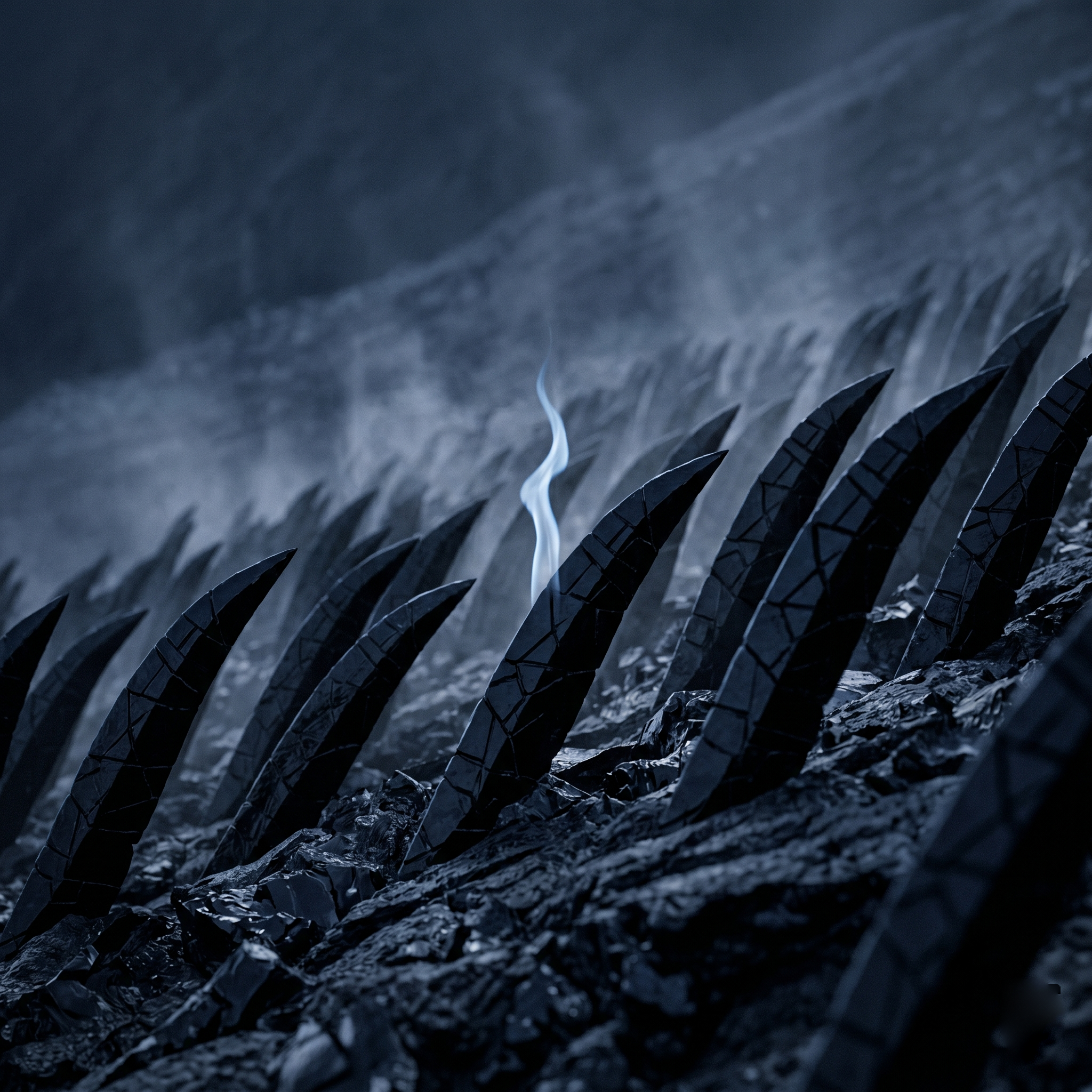
The obsidian scythes of the First Glass Field and Deep Glass are sharp on every edge and reflective on every face. They cannot be gripped safely with standard climbing gloves — the edges cut through Kevlar-weave in three to four hours of sustained contact. The Tohu climb barefoot, and their feet' sensitivity allows them to find the safe edge of each blade as naturally as a person finds a doorknob in the dark. No hunter has replicated this.
The glass is disorienting. Every blade is a mirror. On a clear morning, the field doubles the sun and throws it back at eye level. Climbers routinely emerge from the glass fields with cuts they did not feel accumulating — the glass edge is sharp enough that it cuts without the pressure signal the body usually associates with injury. By the end of Day 2, most expedition members have multiple lacerations on hands, forearms, and lower legs.
In the Deep Glass especially, the upright blades narrow the climbing corridor to body width. Movement becomes a sideways threading. Arms cannot be fully extended. The mirrors carry your reflection along beside you, and it is never quite right — stretched, tilted, watching you out of the rock. This is psychological as well as physical. Climbers who stop looking sideways do better than those who keep tracking their own reflection.
By the end of the Second Day, the slope behind a climbing party is marked with a thin bright line of blood drops on the black glass — the accumulated small cuts leaving a visible trail. The Tohu have observed that the width and density of this blood trail correlates roughly with how much glass each person gave the mountain, which is a proxy for how well they moved through it. A person who moved correctly leaves a thinner trail. A person who gripped and grabbed and fought leaves a broader one. The mountain is always recording.
Peril 5 — The Hollow Crust
The Crust is a glass roof over a network of old lava tubes. Its failure mode is not gradual. It does not creak, or bend, or develop visible cracks as a warning. When weight exceeds the threshold, the glass transitions from floor to air with no intermediate state — no crack, no delay. A section the size of a room becomes nothing, all at once. The person standing on it follows.
The Long Span — a 40-step bridge of crust over the widest known lava tube — is the place where the mountain reads weight most precisely. The Tohu can cross it by reading the ground through their soles: the solid crust gives a dead no underfoot; the hollow section gives a question — a faint give, a distant echo. A barefoot person who has spent fifty years learning the difference can map a route. No boot or sensor replicates this.
The single most important rule for the Crust: empty hands. Full arms. The Crust demands that a climber be able to redistribute weight in the fraction of a second the glass offers before it fails. If both hands are occupied, that moment cannot be used. The mathematics of this are not complicated. The Tohu have stated it as plainly as they state anything. The mountain has enforced it more plainly still.
"Hendrik. Hear me. The bridge take a man with empty hands. Not a man with full hands. The stone not hate you. The stone not know rich, not know poor. The stone know one thing only, same as me — it know your weight. Put the cases down. They stay here. They wait. Nobody you can send for you. Put them down now. Or the span keep you."
Peril 6 — The Vent Fields
The fumaroles of Zone 6A open and close on the mountain's own schedule, venting the concentrated acid atmosphere of the volcanic interior directly to the surface. Unlike the Phlogiston-V, the vent vapour does not judge. It does not read karmic weight or metabolic chemistry or the state of your soul. It is the furnace under the lid breathing in its sleep, and you happened to be in the path of the breath.
The vapour that emerges from a waking vent smells, very briefly, almost pleasant — a mineral sweetness, a sharp clean note. This pleasantness is misleading and is over within the first breath. The acid takes the eyes first: they slam shut and stream and will not be opened. The chest, in its panic, forgets the protocol and begins to gulp. Gulping is ruin. The only correct response to a vent encounter is the chain — every person's hand on the next person's shoulder, eyes shut, mouth shut, breathe through the shirt fabric, follow the Tohu out. You cannot see. You cannot think clearly. The Tohu can. Follow them.
If the chain breaks — if someone lets go and turns — they will save themselves by moving away from the chain into the cloud. This is the instinct. This is the wrong direction. The Tohu's protocol does not allow for this: if the chain breaks, the Tohu who hears the break turns back. What the Tohu cannot do is hold three lives while chasing a fourth. The calculus is ugly and the Tohu know it and have made their peace with it.
Peril 7 — Acid Storms
Pyros generates intense local storms that can arrive within ninety minutes of the first visible weather sign. The island's glass surface interacts with lightning in a way that is unlike any other environment on earth: lightning strikes once and then runs, facet to facet, down the entire slope as a continuous web of white that persists for the duration of the electrical surge. The thunder is not behind the flash. It is inside it, in the rock, in the chest.
Acid rain from these storms finds every open wound, every exposed mucous membrane, every crack in gear. During a full storm on the glass, the rain and the existing surface cuts make each other worse: the acid of the rain activates what the glass opened, and what the glass opened gives the acid a direct route inward. This is also the scenario in which grey lichen exposure accelerates, as rain moves it into existing cuts.
The survivable storm is the storm you are tied into solid rock before it arrives. The company's route includes three marked overhang shelters in the upper zones. The Tohu can identify additional shelter by reading the rock. On the fourth night of the most recent major documented expedition, a storm hit the third camp with no warning. All three remaining climbers survived because the Tohu had anticipated the weather from an afternoon's observation of the horizon colour and the cessation of the upper-elevation heat movement, and had anchored them under an overhang with adequate rope before dark.
The Tohu categorize all Pyros deaths into three types. The first is the fire that judges: Phlogiston-V ignition, caused by what a person carried in their metabolic history. The second is the weight: crust collapse, glass wounds, falling — caused by what a person physically carried or could not put down. The third is the mountain breathing: vents, acid storms, the caldera's own indifferent exhalation — caused by nothing about the person at all. The third kind is the one the Tohu find hardest. The first two, they can see coming. The third they cannot. It is the only part of Pyros they acknowledge as outside their craft.
Safety Summary — What the Mountain Asks of You
The Tohu have been walking Pyros barefoot for a thousand years without losing a single guide to the mountain. Their survival protocol, distilled, is:
- Arrive metabolically clean. No alcohol for at least 10 days before the ascent. Manage stress aggressively in the 30 days prior.
- Breathe small. Above the Lodge, the mouth is a door. Keep it small. Through the nose, slow, always.
- Empty your hands on the Crust. There is no version of the Long Span that ends well for a person carrying things in their fists.
- Keep the chain unbroken. In any vent or yellow-air encounter, do not let go of the shoulder in front of you regardless of instinct.
- Cover every wound every evening. Check for grey lichen contact. Do not wait for symptoms. Grey lichen is not symptomatic until it is dangerous.
- When the rope comes down, consider taking it. The Tohu have watched thirty years of hunters refuse the rope. The body that refused the rope is, in almost every case, still on the mountain.
- Know your why. This one is the Tohu's and cannot be explained further in a safety brochure. Know what you are climbing for, and know it fully, and make sure it is something that cannot be reduced to yourself.
"Too much fat. Too much box. Stone know you are heavy. Step here."