Who the Tohu Are
The Tohu are a lineage of ascetic islanders who have lived in the shadow of the Pyros caldera for generations before recorded history. The word Tohu — in their language — carries two meanings that their people have never separated: the steady shadow and he who sees the weight. Both meanings apply at once.
Physically, they are built like weathered ironwood: wiry, deeply bronzed by volcanic ash and open-ocean sun, with clear, unblinking eyes that seem to look straight through a person's skin to read what is underneath. They wear no high-tech gear. They navigate the razor-sharp obsidian fields barefoot, wearing only simple, tightly woven mats of dried Pandanus leaves on their lower bodies. A Tohu climbs Pyros in the same manner his grandfather climbed it, because nothing has ever improved upon bare feet for reading the difference between solid glass and hollow glass, and nothing ever will.
They are not guides in the sense a climbing company uses that word. A guide knows the path, and the path on Pyros — the least sharp way through a field of knives — is nothing. Any bleeding person finds the path. The company does not pay the Tohu to know the path. The company pays them to stand on the black rock before the boat has touched it and say, out of thirty years of looking at soft rich people in clean coats, whether the mountain will let each one live.
The Craft of Weight-Reading
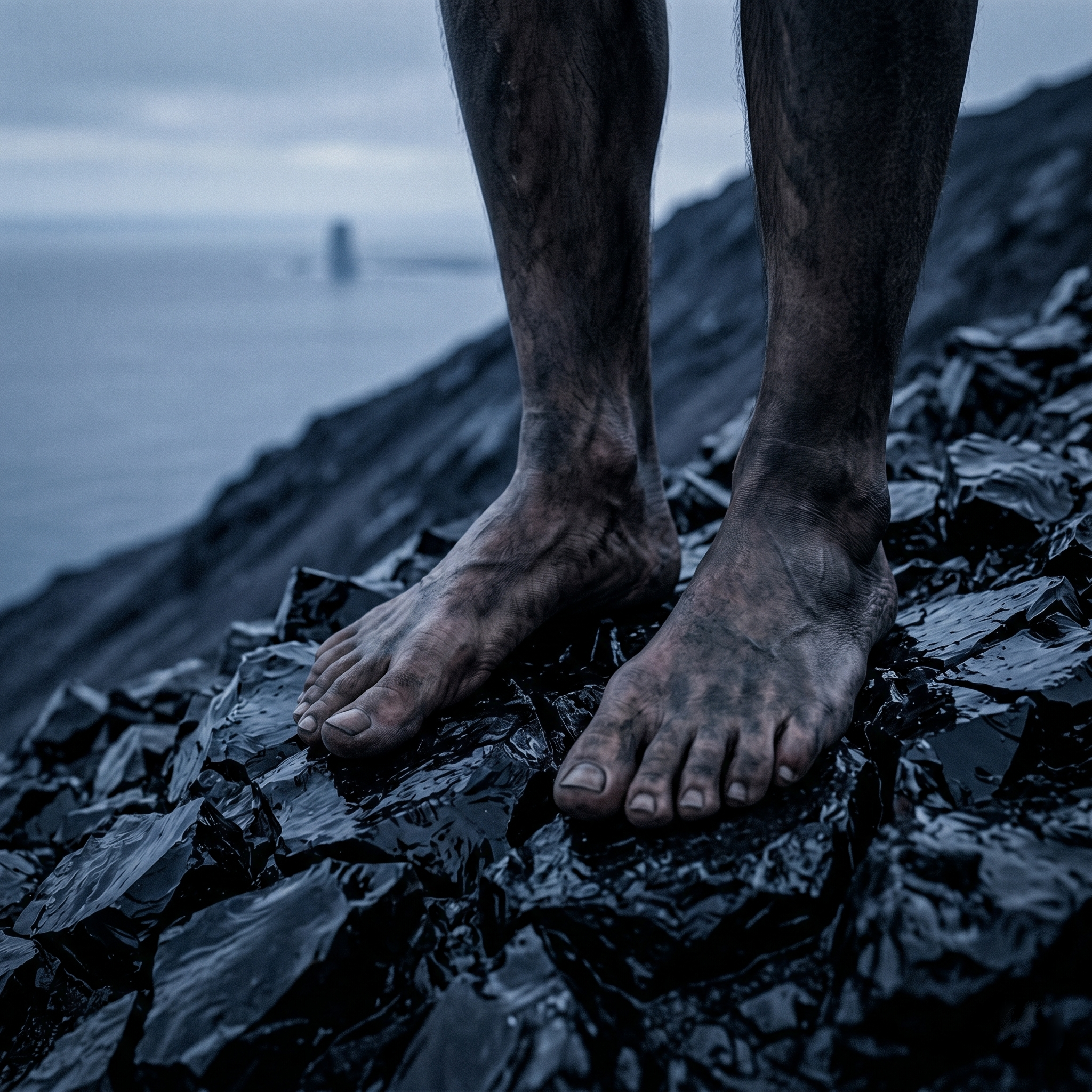
The Tohu at the rim — fifty years of learning to read what a body is made of
The Tohu's craft is the reading of what he calls weight — not the body, which he dismisses as a rumour — but the other weight, the one stitched under the skin. It is made of everything a person has done: every cup after the cup that was enough, every soft year, every time they stepped on someone smaller to stand a little higher. None of it washes off. The world keeps no books but forgets nothing, and a person carries all of it up the mountain on their back like a sack of wet sand.
The Tohu can read this weight because it has a smell. Not a metaphorical one. The metabolic breakdown products of sustained human excess — alcohol, cortisol, the chemical signatures of chronic greed and lifetime overindulgence — are volatile organic compounds. They rise off a person in trace quantities from breath and skin. The Tohu, fifty years barefoot on a mountain saturated with the gas that finds these compounds, has learned to read them the way other people read a room: as information, arriving all at once, before a word is spoken.
The weight the Tohu reads is entirely backward-looking. It is the trail. The wake. The done and the over. This is the craft's strength, and it is also its blind spot: it cannot see one inch into what a person has not yet done, into the obligation pulling forward out of their chest into the dark. Thirty years of boats taught the Tohu to read backward perfectly. The most recent expedition taught him that backward is only half of what moves a person up a mountain. He is still working on the other half.
Denisovan Heritage
The company's geneticists, on the sixth expedition, ran a study of Tohu blood composition. They found approximately 15 percent Denisovan ancestry — a genetic heritage associated with populations throughout Melanesia and, specifically, with extraordinary adaptation to low-oxygen environments. This explains why the Tohu, unlike every other human category that has set foot on Pyros, loses no meaningful blood oxygen on the mountain. They are the island's first children. The mountain does not drink its own.
The Tohu's own explanation of this fact predates the genetics by a thousand years: "We are the island's first children, and the mountain does not drink its own." The company man and the grandmother, the Tohu has observed, were naming one thing in two tongues, and his grandmother's tongue was the more honest one, but he did not say so at the briefing. He gave them the slow face and let them keep their science.
The Tohu's Language
The Tohu speaks to hunters in a broken, fragmented English that strips language to its minimum. He does not speak this way because his English is poor — it is not poor; he follows every word of five days of evening confessions into a camera without missing a syllable. He speaks this way because this is the register of the mountain, and the mountain does not do complexity. It does simple, heavy, plain. The Tohu matches it.
Collected Sayings of the Tohu
Planning Your Expedition
All expeditions to Pyros Island require prior authorization from the International Heritage Trust in coordination with the Tohu Cultural Preservation Council. Authorization is granted annually to a maximum of eight climbers across all expeditions in a calendar year. Demand substantially exceeds supply. The company maintains a waitlist. Contact details are on file with the Heritage Trust.
The Five-Day Window
The FDA — the company's shorthand for the international medical oversight council that reviewed Pyros safety data — has established a firm five-day limit for non-Tohu time on the island above Lodge elevation. This is not a guideline. After five days in the Phlogiston-V atmosphere, the blood oxygen depletion crosses a threshold that makes further climbing not merely difficult but non-survivable without intervention. The company has never exceeded this window, and no Tohu has recommended exceeding it.
Day 1 is travel, arrival, and Lodge briefing. Days 2 through 4 are ascent. Day 5 is the Sieve, the Rim, the crater visit, and the descent. The descent from rim to Lodge requires six to eight hours. The math is tight. It has always been tight.
The Lume System
At the Lodge briefing, each climber receives a lume: a ceramic-sealed blood-oxygen reader that clips to the end of a finger and glows with a green number. Every other piece of technology the company has ever sent up Pyros has been destroyed by the mountain's acid atmosphere within hours. The lume is the exception. The mountain eats the drones, the sensors, the bright screens — the eyes, the comfort, the maps. It leaves you the one machine that counts you down. The mountain has no quarrel with a clock.
The lume reports continuously to the company's base station. When a reading drops below 70, the company is obligated to dispatch an evacuation team with oxygen and a stretcher. The climber may refuse. Refusing requires a signed paper. The paper transfers all liability to the climber. The company is then a witness, not a keeper. In thirty years, the Tohu has watched many climbers refuse the rope. The rope is an honest offer. Almost no one takes the rope.
The Lodge
The Lodge on the shore is the last soft place on Pyros. The company keeps it well: cold drinks, woven chairs, a long open room with the sea in every window. Night 1 is spent at the Lodge. This is the night for the briefing, the lume assignment, the familiarization walk of the lower shore, the velu identification exercise, and — for most hunters — the last sleep that is not thin and full of holes.
The Lodge has a veranda that faces the mountain. On the night before ascent, if you find yourself unable to sleep, go out there. The shore at night is the one gentle thing Pyros owns. The glass cools. The sea works the rock, slow and patient. If the Tohu is also awake — and the Tohu is always awake, the night before a climb — he will sit with you. He will not volunteer much. But if you ask the right questions, he will answer them honestly, in the heavy pieces his mountain allows. Ask about the weight, not the path. The path will find itself.
What the Mountain Takes — Gear Attrition by Day
| Drones & aerial sensors | Day 2, hours 2–3 |
| Wrist biometric sensors | Day 2, by noon |
| Rebreather filters | Day 3 morning |
| Climbing gloves (Kevlar-weave) | Day 2–3 (edge-cut through) |
| Spare food, stoves, folding tools | Deep Glass (jettisoned as weight) |
| Second coats & spare boots | Deep Glass (shed on the slope) |
| Maps & printed navigation aids | Day 2 (useless without drone eyes) |
| The lume | Survives all five days |
The pattern is always the same. The company dresses the hunters in the best gear available. The mountain undresses them. By Day 3, each climber is essentially carrying water, a sleeping mat, and the lume the company built not to die. Everything else the mountain has taken, or the physics of thinning blood has made too heavy to carry, or the climber has left on the slope. The mountain leaves you the one machine that counts you down.
Bring what you are made of. Everything else is weight.
The Cooler — What You Need to Know
The company sells a cold-case — a sealed, ceramic-insulated unit designed to slow the turning of a cut fruit of Maloa's Blood. One cooler is expensive enough to buy a comfortable house in most cities. The company's tested claim is a 48-hour delay in molecular collapse. The Tohu's comment: a delay is not a prevention, and the mountain's law is not "delay the fruit." But the cooler is legal, and the company stands behind its paper, and the choice of whether to bring one is yours.
What the record shows: one cooler has been successfully used to transport a cut fruit from the caldera floor to the crater rim — approximately 300 metres of elevation, over approximately two hours. The fruit was consumed at the rim. Both carrier and consumer survive as of this writing. The Tohu does not consider this a proof of the cooler. He considers it a proof that the cooler bought two hours, and the two hours were used correctly.
The Question You Must Answer Before You Come
The company has no way to ask this question at the booking stage, and the lawyers have advised them not to try. But the Tohu asks it, silently, of every person he counts off the boat. He has asked it of four hundred hunters and received, roughly, three categories of answer.
The first answer is: for more of what I already have. More years in the same room, more time at the same table, more mornings of the same calibre. This is a real and honest answer and it is the answer of most people who come. The Tohu reads it clearly and has a reasonably good sense of what the mountain does with it, which is not uniformly fatal but which has a particular set of correlates.
The second answer is: to win. The twenty-five years as an asset to hold, a position to take, a summit in a life of summits. The Tohu reads this very clearly and has an even more specific sense of what the mountain does with it.
The third answer is the one the Tohu spent thirty years not reading: for something out past the edge of myself. Not for more of the same room. Not to win. For something specific and external that requires the years — not in the abstract but in the concrete, a named obligation to a named other person, a gate on a specific morning that someone has to be standing at. A person carrying that answer, the Tohu has learned, approaches the Sieve differently. The gas finds, in their breath, nothing for which it has a use.
Who are you climbing for?
If the full, honest answer to this question is "myself" — that is not a disqualifying answer. Many honest people have climbed for themselves and some have succeeded. But know the answer before you stand on the black rock. The Tohu will have read it off you before you finish shaking his hand. The mountain will have confirmed it before you cross the first line.
On the Descent
The descent from the crater rim to the Lodge runs six to eight hours and should be begun within two hours of returning to the rim from the caldera visit. The descent is faster than the ascent — elevation is working for you — but the body has been through five days of thin blood and this is not the time to confuse speed with capacity. People have been lost on the descent. The glass is still the glass. The grey lichen is still in the cracks. The Phlogiston-V is still in the air.
The mountain does not stop being the mountain because you have the years in you. It does not become sentimental, or easy, or congratulatory. The Tohu, on the descent after the most recent expedition, was covering a stretch of the First Glass Field with two of the three remaining party members when the field — the entire field, the whole slope below them — began to slide. A Pyros tremor running through a glass mountain produces not a shudder but a shear: the obsidian scythes cracked at their roots in their thousands and the whole field began to move, a slow grinding river of black blade and broken mirror, carrying everything with it toward the lower dark.
The Tohu found the spine of older rock running down through the moving glass and led them across it. One of the two remaining climbers — already weakened past the company's safety threshold — danced the sliding glass the way a champion dances a specific kind of dance: light, quick, three touches on three different moving blades, each gone before the blade could carry her. She had not learned this from the Tohu. She had learned it from her granddaughter, who had learned it from dancing, who had learned it from her. The bloodline. Going down a mountain of glass on its own schedule, being precisely the person she needed to be.
The mountain is not over until the black sand is under your feet and the boat is in the water. Possibly not even then.
"Tohu is the word for what I do, not the word for who I am, and I know the difference, because in my own country I have spent fifty years being a word people said instead of my name."
For expedition authorization and waitlist registration, contact the International Heritage Trust through official channels.
The Tohu Cultural Preservation Council receives 15% of all expedition fees in support of oral tradition documentation.